Caffeine for Your Health — Too Good to Be True?

Recent research has shown that coffee, in particular, may help prevent diseases like stroke and certain cancers, lower our risk of Parkinson's and dementia, and boost our concentration and memory. Partly that's because coffee beans are seeds, the National Institutes of Health (NIH) reminds us, and like all seeds, they're loaded with protective compound

The top ten most expensive cars in the world

The cars on this list, though, are a little different. Take the gorgeous new Ferrari LaFerrari. Even if you do happen to have a spare $1.13 million lying around, don’t bother calling your Ferrari dealer. If Ferrari thinks you deserve one of its 499 masterpieces, it will call and offer the privilege of such a masterpiece to you.

Husband,Say No To Veggies

Its Time for men to ditch the soy as study reveals a vegetarian diet lowers sperm count.

Why do we always use “x” for everything in math?

For hundreds of years, x has been the go-to symbol for the unknown quantity in mathematical equations. So who started this practice?

11 Facts about Chocolate

Chocolate is a typically sweet, usually brown, food preparation of Theobroma cacao seeds, roasted and ground, often flavored, as with vanilla. But Do u know what it does?

Showing posts with label Fact. Show all posts

Saturday, December 20, 2014

Amazing Banana

Did you know that bananas can make you happier?


Bananas are a versatile, sweet, tasty and healthy snack. They can help you keep fit as well as help overcome or prevent a substantial number of illnesses and conditions.Bananas contain three natural sugars – sucrose, fructose and glucose combined with fibre. A banana gives an instant, sustained and substantial boost of energy.Research has proven that just two bananas provide enough energy for a strenuous 90-minute workout. No wonder the banana is the number one fruit with the world’s leading athletes.


DEPRESSION
According to a recent survey undertaken by MIND amongst people suffering from depression, many felt much better after eating a banana. This is because bananas contain tryptophan, a type of protein that the body converts into serotonin, known to make you relax, improve your mood and generally make you feel happier.
PMS:
Forget the pills – eat a banana. The vitamin B6 it contains regulates blood glucose levels, which can affect your mood.
ANAEMIA
High in iron, bananas can stimulate the production of haemoglobin in the blood and so helps in cases of anaemia.
BLOOD PRESSURE
This unique tropical fruit is extremely high in potassium yet low in salt, making it perfect to beat blood pressure So much so, the US Food and Drug Administration has just allowed the banana industry to make official claims for the fruit’s ability to reduce the risk of blood pressure and stroke.
BRAIN POWER
200 students at a Twickenham school ( England ) were helped through their exams this year by eating bananas at breakfast, break, and lunch in a bid to boost their brain power. Research has shown that the potassium-packed fruit can assist learning by making pupils more alert.
CONSTIPATION
High in fiber, including bananas in the diet can help restore normal bowel action, helping to overcome the problem without resorting to laxatives.
HANGOVERS
One of the quickest ways of curing a hangover is to make a banana milkshake, sweetened with honey. The banana calms the stomach and, with the help of the honey, builds up depleted blood sugar levels, while the milk soothes and re-hydrates your system.
HEARTBURN
Bananas have a natural antacid effect in the body, so if you suffer from heartburn, try eating a banana for soothing relief.
MORNING SICKNESS
Snacking on bananas between meals helps to keep blood sugar levels up and avoid morning sickness.

MOSQUITO BITES
Before reaching for the insect bite cream, try rubbing the affected area with the inside of a banana skin. Many people find it amazingly successful at reducing swelling and irritation.
NERVES
Bananas are high in B vitamins that help calm the nervous system.
Overweight and at work? Studies at the Institute of Psychology in Austria found pressure at work leads to gorging on comfort food-like chocolate and chips. Looking at 5,000 hospital patients, researchers found the most obese were more likely to be in high-pressure jobs. The report concluded that, to avoid panic-induced food cravings, we need to control our blood sugar levels by snacking on high carbohydrate foods every two hours to keep levels steady.

ULCERS
The banana is used as the dietary food against intestinal disorders because of its soft texture and smoothness. It is the only raw fruit that can be eaten without distress in over-chronicler cases. It also neutralizes over-acidity and reduces irritation by coating the lining of the stomach.
TEMPERATURE CONTROL
Many other cultures see bananas as a ‘cooling’ fruit that can lower both the physical and emotional temperature of expectant mothers. In Thailand , for example, pregnant women eat bananas to ensure their baby is born with a cool temperature.
So, a banana really is a natural remedy for many ills. When you compare it to an apple, it has FOUR TIMES the protein, TWICE the carbohydrate, THREE TIMES the phosphorus, five times the vitamin A and iron, and twice the other vitamins and minerals.. It is also rich in potassium and is one of the best value foods around.
So maybe its time to change that well-known phrase so that we say, ‘A BANANA a day keeps the doctor away!’
And don’t you forget that you can make your shoes shine, wiping them with the inside of banana.


Monday, December 15, 2014

Oldest Cities in the World

10. Beirut, Lebanon


10. Beirut, Lebanon
Inhabited since: 3000 BC


The first historical references to Beirut date to the 14th century BC, in letters to the pharaoh of Egypt, and it’s still going strong as the capital of Lebanon. Although the “Paris of the Middle East” has been scarred by wars and local unrest, it’s still a culturally rich destination with thriving food and nightlife scenes.


9. Gaziantep, Turkey

9. Gaziantep, Turkey
Inhabited since: 3650 BC

Gaziantep, in southern Turkey, is just 60 miles north of another city on this list: Aleppo, Syria. Some of its popular sites include the ruins of ancient Zeugma, the Gaziantep Fortress, and the Gaziantep Zoo, which is one of the largest zoos in Turkey. 


8. Faiyum, Egypt

6. Faiyum, Egypt
Inhabited since: 4000 BC

Egypt’s oldest city occupies part of the ancient site of Crocodilopolis, which worshipped Sobek the Crocodile God and a sacred crocodile named Petsuchos. You can still find evidence of this past in the mounds north of the city that mark Crocodilopolis. In Faiyum you can find large bazaars, baths, and a popular weekly market. Pictured here is the Hawara pyramid. (Photo:


7. Plovdiv, Bulgaria

6. Plovdiv, Bulgaria
Inhabited since: 4000 BC

Plovdiv, the second-largest city in Bulgaria, has settlements that date as far back as 6000 BC. Evidence of the city’s former conquerors can be found throughout, including a Roman theater, Roman aqueduct, and Ottoman baths. There are also medieval walls, art museums, musical festivals, and much more to visit here.


6. Sidon, Lebanon

6.  Sidon, Lebanon
Inhabited since: 4000 BC 

Some argue that Sidon has been inhabited since 6000 BC, and it might be the oldest and most important city of Phoenician times. Since then it’s been conquered by the Assyrians, Babylonians, Egyptians, Greeks, Romans, and Ottomans.  Despite all this, it remains the third-largest city in Lebanon, with a busy fishing port. One of its most recognizable structures is the Sidon Sea Castle (pictured), which was built by Crusaders in the 13th century.


5. Susa (Shush), Iran

5. Susa (Shush), Iran
Inhabited since: 4200 BC

Shush is the modern name for what was the ancient city of Susa. There are traces of a Neolithic village as early as 7000 BC, and Carbon-14 dating places settlements there around 4200. Susa was a large city during ancient and medieval years, but a Mongol invasion in the 13th century shrunk it greatly and the population now stands at around 60,000. Susa is known as the burial place of the Biblical prophet Daniel, although this is disputed. Visitors can walk through the palace above the tomb.


4. Damascus, Syria

3. Damascus, Syria
Inhabited since: 4300 BC


Some claim that Damascus is the world’s oldest city and that it’s been inhabited since 9000 BC, based on the findings of a settlement further out in the Barada basin. This ranking is based on settlement within the city itself. Damascus has been a vital city since the Aramaeans installed a network of canals and tunnels for water distribution. The city’s historical attractions, including the Great Mosque (pictured) and souk, are formidable, but with the current war in Syria, the country is an extremely dangerous place to enter.


3. Aleppo, Syria

Aleppo, Syria
Inhabited since: 4300

Because modern Aleppo stands right over the ancient city, it’s difficult for archaeologists to determine exactly how old it is. Still, it’s definitely among the oldest on this list, with settlements just north of Aleppo dating to 13,000 years ago. It’s the largest city in Syria, with a medieval citadel towering over the city. Unfortunately the Citadel, like the rest of the city, is off limits to travelers with war raging.


2. Byblos, Lebanon

Byblos, Lebanon
Inhabited since:  5000 BC

Many will argue that this is truly the world’s oldest continuously inhabited city. Indeed, one of them was the 1st Century writer Philo of Byblos. We do know that the Greek-given name “Byblos” inspired the English word for “Bible,” thanks to papyrus being exported through the city. Byblos remains a prime tourism site thanks to its scenic mountains, sandy beaches, preserved historical sites, and annual music festival.


1. Jericho, West Bank(Palestine)

Jericho, Palestine
Inhabited since: 9000 BC


It comes down to this: Has Jericho been continuously inhabited since it was first settled? Some archaeological evidence claims the city has been abandoned and rebuilt, while others insist it’s remained intact. There’s no question that the city’s history goes way back: archaeologists found evidence of more than 20 successive settlements going back 11,000 years. Jericho is 846 feet below sea level and near a spring that feeds the Jordan River. It’s visited by tourists because of its proximity to the Dead Sea and its Greek Orthodox monastery atop the Mount of Temptation – you can take a cable car up to see it.

More Detail:http://www.bbc.com/

Sunday, December 14, 2014

The Truth About Eggs

Eggs are a nutritional powerhouse, but for a while, egg yolks have been demonized in the health-food industry as causing blood-cholesterol levels to skyrocket. Is it true? It's time to set the story straight on the nutritional benefits of an egg.


The Truth: Not only are eggs a fantastic source of lean protein and heart-healthy omega-3 fatty acids, but they contain some pretty important nutrients.


One large egg has roughly 186 milligrams of cholesterol — all of which is found in the egg’s yolk. Since dietary cholesterol was once thought to be the major cause of unhealthy blood cholesterol, egg yolks have been demonized and health nuts stick to eating strictly egg whites. Now, don’t get me wrong — egg whites are a great, healthy source of protein, but there is definitely room for WHOLE eggs in a healthy diet. As long as you haven’t been advised otherwise by your doctor , you can enjoy the many nutritional benefits of a whole egg. So, yes, you can have an egg and eat the yolk too ! Here are a few reasons why.


The real threat to high cholesterol is saturated and trans fats, not dietary cholesterol. Years ago, when scientists learned that high blood cholesterol was associated with heart disease, foods high in cholesterol were thought to be the leading cause of unhealthy blood cholesterol. Now, 25 years later, scientists have come to the conclusion that cholesterol in food is not the true villain — saturated and trans fats have a much greater effect on blood cholesterol. Your body actually needs the cholesterol in meat and eggs to make testosterone, which helps to increase energy and helps to build more calorie-building muscle. In fact, one study at the University of Connecticut found that the fat in egg yolks actually helps to reduce LDL (“bad” cholesterol). So banish the old notion that an egg, specifically the yolk, is hazardous to your health. According to the American Heart Association, the recommended limit of dietary cholesterol is 300 milligrams for people with normal LDL (bad) cholesterol levels — and one egg contains 185 milligrams of dietary cholesterol. (If you have a history of high cholesterol or heart disease in your family, though, you may want to consult your doctor about how to limit your cholesterol intake.)


Whole eggs are full of beneficial vitamins and minerals. Whole eggs are a nearly perfect food, with almost every essential vitamin and mineral our bodies need to function. It is one of the few natural food sources of vitamin D and contains 7 grams of high-quality protein. Whole eggs are also full of omega-3 fatty acids and deliver many of the B vitamins and nutrients — B6, B12, riboflavin, folate, and choline — that, in fact, are believed to help prevent heart disease. L-arginine, an amino acid found in eggs, are critical to the body's production of protein and the release of growth hormones. Another amino acid found in eggs, leucine, also helps the body produce growth hormones as well as regulate blood sugar levels. The yolk itself contains most of these vitamins and minerals, plus half of its protein. When you eat only the egg whites, you’re missing out on all of these nutritional benefits and are getting only 3.5 grams, or half, of the protein.
It’s all in the preparation. If you’re frying your eggs in saturated-fat-laden butter and serving them with saturated-fat-laden bacon — they will have a negative impact on your cholesterol levels. Instead, heat olive oil on low heat in a cast-iron skillet to cook your egg the healthiest way. When cooking omelets, frittatas, or any other dish that involves a larger quantity of eggs, I like to use a mix of whole eggs with egg whites. The reason is that whole eggs do have a decent amount of fat. So, if you’re cooking something with more than two eggs, I recommend subbing in egg whites for some of the whole eggs.
The Bottom Line: Whole eggs are a power food packed with essential vitamins and minerals our bodies need — a majority of these vitamins and minerals are found in the eggyolk. Eating whole eggs in moderation is not bad for your health, but when making dishes with a large quantity of eggs, try to balance the count of whole eggs and egg whites.

Saturday, December 13, 2014

Top 10 Deadly Diseases

Top 10 Deadly Diseases

The human body is capable of many amazing things, but its power can often end in the fatality of thousands. Check out the top 10 deadliest diseases and learn about their causes, symptoms and ways to avoid them!
tuberculosis
TB is a lung condition caused by bacteria called Mycobacterium tuberculosis. It’s an airborne disease that is often successfully treated. Some strains of TB are resistant to conventional treatments. Second-line drugs used to treat these patients are in limited supply. Some strains fail to respond to second-line treatment as well.
In 2012, about 900,000 people lost their lives to TB, according to WHO estimates. The majority of TB-related deaths happen in poorer countries. It is one of the top causes of death for people who have HIV.
preterm-birth-complications

According to WHO, in 2012, as many as 1.1 million deaths were due to prematurity and complications due to low birth weight. Three-quarters of these deaths happen within the first week of life. Lack of skilled medical care makes this a huge problem in developing countries. Many newborn deaths could be avoided with good prenatal and postnatal care.


diabetes-mellitus

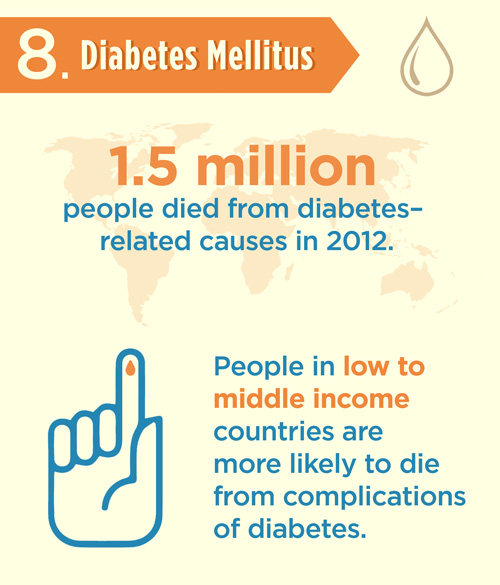
Diabetes is a group of diseases that affect insulin production and use. In type 1 diabetes, the pancreas can no longer produce insulin. The cause is not known. In type 2 diabetes, the pancreas doesn’t produce enough insulin, or it can’t be used effectively. Type 2 diabetes can be caused by a number of factors, including poor diet, lack of exercise, and carrying too much weight.

diarrheal-diseases
In 2012, about 1.5 million people died from diabetes-related causes, according to WHO. People in low to middle income countries are more likely to die from complications of diabetes.Diarrhea is when you pass three or more loose stools a day. When diarrhea lasts more than a few days, your body loses too much water and salt. Death is due to dehydration. Diarrhea is usually caused by an intestinal infection transmitted through viruses, bacteria, or even parasites. This type of infection can easily spread through contaminated water or food. It’s particularly widespread in developing nations that have poor sanitary conditions.
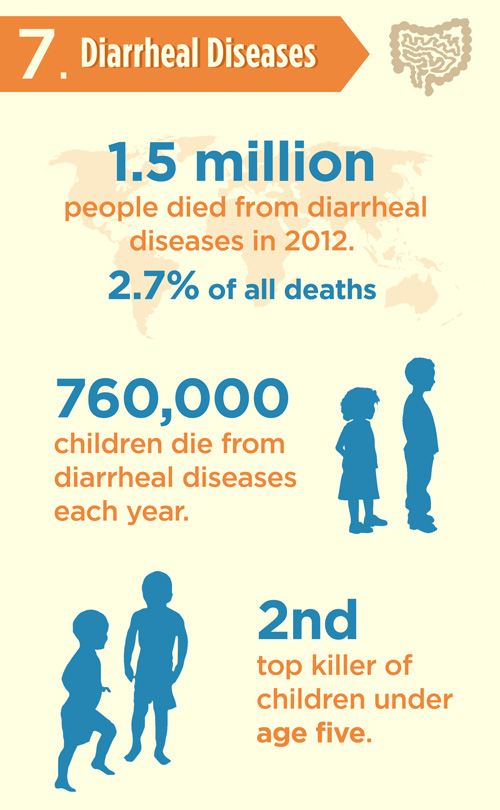
WHO estimates that 1.5 million people died from diarrheal diseases in 2012, which comprises about 2.7 percent of deaths. Fortunately, that’s down from 2.2 million in 2000. Diarrheal disease is the second top killer of children under age five. Tragically, about 760,000 children die from diarrheal diseases each year.
According to a 2009 Unicef report, every year there are about 2.5 billion cases of diarrhea involving children under five years old. More than 50 percent occur in Africa and South Asia. More than 80 percent of child deaths due to diarrhea occur in those regions.
According to Unicef, healthy behaviors such as good handwashing technique can reduce the incidence of diarrheal diseases by 40 percent. Progress is being made in the fight against diarrheal diseases, but much work remains. Improved sanitization and water quality can help prevent diarrheal diseases. Access to early medical intervention can be the difference between life and death.
hiv-aids
hiv-aids
HIV is short for human immunodeficiency virus. It’s a virus that attacks the immune system. HIV can cause AIDS, or acquired immunodeficiency syndrome. AIDS is a chronic, life-threatening condition.
According to the Foundation for AIDS Research (amfAR), since the start of the pandemic, almost 39 million people have died due to HIV/AIDS. In 2013, about 1.5 million people lost their lives to AIDS. That’s about 2.7 percent of deaths worldwide.
By the end of 2012, 35.3 million people around the world were infected with HIV. Every day, about 5,700 more become infected.
Rates vary dramatically by geographical location. HIV is rampant in sub-Saharan Africa, where almost one in 20 adults has it. The region is home to 70 percent of all people who have HIV. Sadly, it’s also home to 91 percent of the HIV-positive children in the world.

trachea-bronchus-lung-cancers

Trachea, bronchus, and lung cancer are all respiratory cancers. The main causes of this type of cancer are smoking, second-hand smoke, and environmental toxins.
WHO estimates that in 2012, 1.6 million people died from trachea, bronchus, and lung cancers. These cancers represent about 2.9 percent of all deaths globally


lower-respiratory-infections
WHO estimates that lower respiratory infections caused about 3.1 million, or 5.5 percent of deaths in 2012. This group of diseases includes pneumonia, bronchitis, and influenza.
Flu season lasts from December through February in the Northern Hemisphere and from June through August in the Southern Hemisphere. The risk is year round in tropical regions.
According to the CDC, about 20 percent of travelers returning to the United States seek medical attention for respiratory infection following a trip. Packed cruise ships, hotels, and other close quarters increase risk of transmission and outbreaks of disease.


copd

COPD is a chronic, progressive lung disease that makes it hard to breathe. Chronic bronchitis and emphysema are types of COPD.
copd-state-facts
About 3.1 million deaths were attributed to COPD in 2012, according to WHO. That represents about 5.6 percent of deaths, a rate that has held steady since 2000. In 2004, about 64 million people around the world were living with COPD.
The main cause of COPD is tobacco — and that means secondhand smoke, too. Another factor is air pollution, both indoors and out. COPD affects men and women at about the same rate. There’s no cure for COPD, but its progression can be slowed down with medication.
The American Lung Association estimates that in 2011, 12.7 million adults in the United States had COPD, but even more showed some sign of lung problems. There’s a great variation in the number of cases from state to state. In 2011, about 4 percent of people in Minnesota and Washington had COPD. In Alabama and Kentucky, it was more than 9 percent.


stroke
A stroke is when an artery in the brain is blocked or leaks. Oxygen-deprived brain cells begin to die within minutes.
Stroke was responsible for 6.7 million deaths around the world in 2012, according to WHO. That figure represents about 11.9 percent of all deaths. CDC figures show that nearly 130,000 people in the United States die of stroke each year — that’s one person every four minutes. About one in four strokes occur in people who have had a prior stroke. Stroke is also a leading cause of disability.
Risk factors for stroke are similar to those for CAD. In general, good health habits can lower your risks.

coronary-artery-disease
The deadliest disease in the world is coronary artery disease (CAD). CAD, also called ischemic heart disease, occurs when the blood vessels that supply blood to the heart become narrowed. The World Health Organization (WHO) estimates that about 7.4 million people died of ischemic heart disease in 2012. That was about 13.2 percent of all deaths.
In the United States, about 600,000 people die of heart disease every year, according to the Centers for Disease Control and Prevention (CDC). That makes it the deadliest disease in the U.S., as well as the world. In the U.S. the most common type of heart disease is CAD, which takes about 380,000 lives each year.
Among the risk factors are high blood pressure, high cholesterol, and smoking. Regular exercise, good nutrition, and weight control can help lower your risk of developing CAD.
Where you live matters. Although it’s still the leading cause of death, mortality rates have declined in many European countries and in the United States. This may be due to better prevention and access to quality healthcare. However, in many developing nations, mortality rates due to CAD are on the rise.
EXTRA:
They didn’t make the top 10 deadliest disease list, but these diseases are definitely worth noting.
Malaria is caused by a parasite that infects mosquitos. People get it from the bite of an infected mosquito. Malaria caused about 627,000 deaths in 2012, according to WHO. Sub-Saharan Africa took the brunt with 90 percent of all malaria deaths. Malaria is not contagious.
Measles is a contagious viral disease that can be prevented through immunization. In 2010, it killed about 139,300 people around the world, according to the CDC.