Caffeine for Your Health — Too Good to Be True?

Recent research has shown that coffee, in particular, may help prevent diseases like stroke and certain cancers, lower our risk of Parkinson's and dementia, and boost our concentration and memory. Partly that's because coffee beans are seeds, the National Institutes of Health (NIH) reminds us, and like all seeds, they're loaded with protective compound

The top ten most expensive cars in the world

The cars on this list, though, are a little different. Take the gorgeous new Ferrari LaFerrari. Even if you do happen to have a spare $1.13 million lying around, don’t bother calling your Ferrari dealer. If Ferrari thinks you deserve one of its 499 masterpieces, it will call and offer the privilege of such a masterpiece to you.

Husband,Say No To Veggies

Its Time for men to ditch the soy as study reveals a vegetarian diet lowers sperm count.

Why do we always use “x” for everything in math?

For hundreds of years, x has been the go-to symbol for the unknown quantity in mathematical equations. So who started this practice?

11 Facts about Chocolate

Chocolate is a typically sweet, usually brown, food preparation of Theobroma cacao seeds, roasted and ground, often flavored, as with vanilla. But Do u know what it does?

Showing posts with label Technology. Show all posts

Wednesday, December 17, 2014

Future Car:Lamborghini Ferruccio

Future Car:Lamborghini Ferruccio

 Lamborghini Ferruccio Concept by Mark Hostler picture - doc442969
The year 2013 marks the 50th anniversary of the famous Italian sports car brand, Lamborghini . In 1963, Ferruccio Lamborghini started the company with the intent of creating supercars to compete with models from Ferrari Ferrari. Now, as a celebration of this event, and as an homage to Ferruccio Lamborghini, Mark Hostler, a transportation design student at Staffordshire university, has created the Lamborghini Ferruccio Concept.


 Lamborghini Ferruccio Concept by Mark Hostler picture - doc442974According to the designer, the concept is "a car that takes inspiration from the company’s lineage, and also showcases the current design language and innovations of the company in their trademark flamboyant style." The concept’s front end, bonnet, and super-wide rear end were inspired by the Countach .


 Lamborghini Ferruccio Concept by Mark Hostler picture - doc442977


 Lamborghini Ferruccio Concept by Mark Hostler picture - doc442972 The front and rear wings were inspired by the Miura , while the sharp nose and mirrors, and aggressive air intakes across the body and roof take their inspiration from the current Lamborghini design language.
The concept was designed to use a small 5.0 liter V12 engine with two turbochargers and feature direct injection technology

Wednesday, December 10, 2014

The top ten most expensive cars in the world

10. McLaren P1 $1.1M

McLaren P1

From the same manufacturer as the legendary F1, the P1 might just live up the insane legacy of the first 230 mph production car.

Lurking underneath the carbon fiber is a 3.8 liter twin-turbo V8 which when paired with the onboard electric motor is good for 903 horsepower and 664 lb-ft of torque. The right way to think about this isn’t even as a hybrid, but like a roadgoing Formula 1 car with a Kinetic Energy Recovery System. This will help you get over the fact that you can only get 9 miles on the battery.

Straight ahead speed isn’t quite as lunatic as it was on the F1, with the top speed limited to a measly 217 mph. But it will get you to 60 mph in less than 3 seconds, and make it from 0-182 in 16.5 seconds, twice as fast as Ferrari 458 Italia. It will also grip and brake like the amazing Spiderman on PEDs.

McLaren has gone all out on the quality control, when engineers test the waterproof seals the car is doused in nearly 4,000 gallons of water.

If you want one, act now because they just went into production and most of the 375 are spoken for.


9. Hennessey Venom GT $1.1M

Hennessey Venom GT
The engineers over at Hennessey may need a little less testosterone and a little more Thorazine. That hasn’t stopped them, though, from achieving something that most physicists consider impossible. This little company has produced the fastest ever production car, capable of 271 mph.
They say everything is bigger in Texas and the Lone Star State-based tuning house is happy to that statement correct.
The Venom GT is filled with enough horsepower to stretch across the Lone Star State itself, packing a mind-blowing 1,500 horsepower mined from a poisonous 7.0-liter twin-turbo V8 engine. 0-60 is pegged at two seconds. The riotous acceleration doesn’t end there, though, the Venom claims a top speed of 287 mph.
If the CERN particle accelerator keeps having trouble they might just think about driving a Venom GT around it instead. Or maybe NASA could use it for deep space travel.
At just $1.1 million this car is almost a bargain considering it can out strip everything on this list, except maybe: the mighty Koenigsegg One:1.


8. Zenvo ST1 $1.2M

Zenvo ST1
Denmark may only be known for its massive butter consumption and as the setting of Hamlet. But the Zenovo ST1 is definitely ‘to be.’
Well, only three of them will actually ‘be.’ Apparently because they need to be hand carved from adamantium and Thor’s hammer.
The results though are impressive, the ST1 is propelled by a turbo supercharged 7.0-liter V8, which might have been nicked off of a P-38 Lightning. This monster powerplant is good for a top speed of 233 mph and a 0-60 time south of three seconds.
Unfortunately for the mighty Dane, its initial exhibitions have not gone well. It nearly killed Jeremy Clarkson of Top Gear by setting him on fire and then didn’t even go that fast.
No wonder it looks so angry. Don’t count the ST1 out yet though, because Zenvo is hard at work.


7. Ferrari La Ferrari $1.3M

LaFerrari
Italian for ‘the Ferrari,” the Ferrari the Ferrari’s name might be a bit silly. But the everything else is absolutely spectacular.

In true Italian fashion, at the heart of this stallion is a V12. By itself, this mighty heart pumps out 789 horsepower. But if you hit the defibrillator and electrocute that sucker, with the Kinetic Energy Recovery System (KERS), you can get up to 950 hp.
Because this thing weighs rather a lot less than your average Ford Focus, the tidal wave of power will drive you to 120 mph in less than seven seconds; faster than most cars can get you to 60 mph.
If Ferrari hasn’t already called to offer you one of the 499 LaFerraris it has built, you are out luck. You are just going to have to look for one secondhand on the Dubai Craigslist.


6. Pagani Huayra $1.3M

Pagani Huayra
Welcome to the best car that no one can pronounce. Named for the Incan “God of Winds,” the Huayra’s (why-rah) offers performance that a deity would be envious of.
Powered by an AMG 6.0-liter V12 with two turbochargers, the Huayra is good for 230 mph. And at 740 lb-ft, more torque than your average pantheon.
Styling is very Pagani. The car boasts gullwing doors, the patented Pagani antenna/side mirrors and some of the best leatherwork you will ever see.
For the low, low price of $1.3 million, this car is such a bargain you might want to buy two.


5. Koenigsegg One:1. $2.0M

Koenigsegg One:1
When it comes to the car world, Koenigsegg has been the crazy uncle off in the corner doing its own thing. Well that business model has really paid off because it has just achieved a very impressive automotive first, a one-to-one power-to-weight ratio in a road car.
This insane machine weighs just 1,340 kilograms and puts out 1,340 horsepower. And that weight includes a full complement of fluids and an average driver. This should make the One:1 the fastest accelerating car – and possibly plane – that money can buy. What do I mean? I mean 0 to 250 mph in under twenty seconds and a claimed potential top speed of 273 mph or more.
In short, there might be more luxurious cars on this list, but there is none that can hold a candle in raw performance.


4. Ferrari F60 America. $3.2M

Ferrari F60
Built to celebrate 60 years of Ferrari in America, the F60 – get it? – is perhaps the most insane Ferrari Roadster ever. The F60 is based on the F12 Berlinetta, a car so crazy it left noted ‘POWEEEEERRRR’ enthusiast Jeremy Clarkson scared.

In addition to that insanity, this bad boy sports blue and white paint in honor of Ferrari’s North American Racing Team, and a cloth soft top that can be raised at speeds of up to 75 mph.
That is a good thing, too, because, at full tilt, the F60 will get to that speed awfully quickly. The F60’s 740-hp V12 will propel the the car to 60 mph in 3.1 seconds and on to a top speed of around 200 mph. Hopefully one of the ten people lucky enough to get their hands on the F60 America will test that out and let us know how fast it really goes.

3. Mansory Vivre: Bugatti Veyron. $3.4M

bugatti-mansory-vivere-front-1500x1000
The Bugatti Veyron is getting to that point in its life where it can wax reflective and nostalgic. That’s where the Legend Meo Constantini comes in. Built to commemorate friend of Bugatti founder, and two-time winner of the Targa Folorio, in a Bugatti 35.

Constantini was just the sort of aristocratic whack-job that made early motor racing great, so its appropriate that Bugatti honored him with such a mental car.
Underneath the Legend is a Grand Sport Vitesse Roadster. It draws a hyper-godly 1,200 hp from its W16. This is good for a top speed of 254 mph. It might be a bit slower than the Veyron Super Sport, but it’s much prettier. The carbon fiber is painted French Racing Blue, and the aluminum is left to its own burnished glory. Maps of the Targa Florio and other racing scenes are laser etched in both the exterior and interior. This isn’t just a face melting speed machine, its also a work of art.

2. W Motors Lykan Hypersport $3.4M
W Motors Lykan-HyperSport
Didn’t know that Lebanon had a car industry? Then you are missing out, because the W Motors’ Lykan Hypersport is one of the most impressive things on four wheels.
Not many details are out about this car yet, but it is purportedly good for 245 mph, and a 0-60 time of 2.7 seconds. Amazingly, this acceleration comes courtesy of a turbocharged V6, which, compared to some of the mammoth V12s sported by cars on this list, seems positively demure.
If those performance figures don’t jump off the page, don’t worry the Lykan Hypersport has an ace up its sleeve. W Motors didn’t just focus on performance, they have the tech madness and sheer excess side of hypercars covered.  Those handsomely aggressive LED lights are covered in diamonds, and the information about how far over the speed limit you are going is conveyed by a holographic display.
All I can say is, “Help me Lykan Hypersport, you are my only hope.”

1. Lamborghini Veneno $4M

Lamborghini veneno roadster 1
We should have expected something this mad for Lamborghini’s 50th anniversary, but somehow we were still surprised. The Veneno is simply jaw-dropping.
It may not be the most beautiful supercar, but it is still one of the coolest. I still have to remind myself that I am actually looking at photos of it rather than a concept drawing or a computer generation.
But the Veneno isn’t all looks and no go. The name is Spanish for “poison” and boy is that appropriate. The naturally aspirated V12 – because turbos are for sissies – hammers out 750 horsepower. This Italian thunderclap will bring to 60 in 2.8 seconds, probably faster than sound can leave your body during a terrified scream.
The big wing on the back is encouraging. Either it will help keep the car on the road or it means that the Veneno is in accordance with FAA regulations, which is good until you realize that means it was designed to fly. Gulp.
It gets better too, because Lambo has recently gone ahead with a convertible version. The “poison” Spyder is just as fast, and even more mental. With speeds approaching 220 mph in an open top car, lets just say you are going to need goggles.
Even the batmobile looks tame in comparison to the Veneno and it probably costs less too.
Want one? That’s a silly question. Of course you do. Unfortunately, the three hard tops are already spoken for, but there will be nine roadsters. They may cost an extra half million dollars, but for something like this thats almost a bargain.
And hey we can all dream. After all, that’s the point of this list.

Monday, December 8, 2014

Creating 3D shape using Ultrasound in Mid Air

Ultrasound Used To Create 3D Shapes In Mid Air That Can Be Seen And Felt


You may not have heard of it before, but haptic technology is all around us. The buzz of your smartphone as you tap the keys, or the rumble of your Wii controller as you smash a tennis ball are both haptic effects. But this touch feedback technology has uses far beyond enhancing your game experience; it’s used in rehabilitation of stroke patients and even surgical training. Now, scientists have invented a new method of haptic feedback using ultrasound, which creates 3D haptic shapes in mid-air that can be seen and felt.
The researchers, who are based at the University of Bristol, envisage that this innovative technology could transform the way that we use 3D haptic shapes. It could lead to touchable holograms to augment learning, or enhanced gaming experience by allowing users to feel features of the game, such as a football. It could even have a place in medicine, for example by allowing surgeons to physically feel tumors by exploring CT scans.
The method, which is described in ACM Transactions on Graphics, exploits an effect produced by ultrasound called acoustic radiation force, which is the scattering and absorption of the acoustic wave. By observing how sound waves behave when they hit an object, it is possible to deduce the shape of the object. The team also realized that it is possible to feel these shapes by focusing complex patterns of ultrasound onto our hands. In doing so, the researchers created air disturbances that could be felt on the skin and seen as floating 3D shapes. The ultrasound patterns cannot be seen by themselves, but the team visualized them by directing the device at a layer of oil so that depressions at the surface appeared as spots when illuminated.
By adding these invisible 3D shapes to 3D displays, scientists can create something that can be both seen and felt. The team also demonstrated that users were able to match images of a 3D shape to the shape produced by the device.
“Touchable holograms, immersive virtual reality that you can feel and complex touchable controls in free space, are all possible ways of using this system,” lead author Dr. Ben Long said in a news release. “In the future, people could feel holograms of objects that would not otherwise be possible, such as feeling the differences between materials in a CT scan or understanding the shapes of artefacts in a museum.”


For more detail:http://www.iflscience.com/

Sunday, December 7, 2014

Escape From the pit-black Hole

Scientists have argued that light cannot escape the pull of a black hole.
But something might. That escapee would be a kind of energy called Hawking radiation. To date, no one has ever witnessed Hawking radiation. But one scientist thinks he may have recorded evidence of the next best thing: energy escaping an experimental type of black hole in the lab. If other scientists can repeat his findings, this would offer evidence that Hawking radiation exists.

 This illustration shows a black hole devouring a star. A black hole should devour everything in its gravitational pull. Physicist Stephen Hawking, though, proposed that some energy might escape. New data suggest how that could happen.


Daniele Faccio calls the new experiment “amazing, groundbreaking work.” A physicist at Heriot-Watt University in Edinburgh, Scotland, he did not take part in this research. The new work, he says, “demonstrates something that everyone thought was impossible.”


A black hole is a place in space where a lot of mass is packed into a small volume. A supermassive black hole has such intense gravity (owing to its great mass) that its attractive force could play a big role in holding an entire galaxy together. Scientists used to believe that nothing — not even light — could escape a black hole. But in the 1970s, physicist Stephen Hawking at the University of Cambridge, in England, introduced a radical new idea. He suggested that some particles could, in fact, escape.

His idea came from the world of quantum physics. Its rules govern the motion and behavior of particles that are smaller than atoms. According to quantum physics, pairs of particles are always popping into existence. But once they collide, they vanish again.

What would happen if these particles formed at the edge of a black hole and only one fell in, Hawking wondered. The other particle might escape, he concluded. And that would look like this particle was coming from the black hole. Over time, enough of these surviving particles — eventually called Hawking radiation — could make an entire black hole evaporate.
For decades, scientists have been looking for Hawking radiation. Getting experimental proof, however, has been tricky. After all, it would only show up at black holes, and physicists have no access to them. (The nearest is several thousand light-years away.) Hawking radiation also would be so faint that even telescopes couldn’t pick it up.

Jeff Steinhauer is a physicist at Technion-Israel Institute of Technology in Haifa. For his new experiment, Steinhauer didn't build a real black hole. Instead, he built an analog, or a device that mimics some properties of the real thing. Instead of light and matter, his lab-built black hole traps sound.

Similar to light, sound travels as a wave. To understand how Steinhauer’s black hole works, imagine a jet flying faster than the speed of sound. Now imagine that the jet makes a noise. Perhaps the pilot knocks on the cockpit window. Because the jet is flying so fast, sound waves from that knock can't move ahead of the jet. All stay behind it.

Steinhauer’s experiment created a similar situation. It accelerated a stream of ultracold atoms to superfast speeds. The point where atoms were moving faster than sound became a sort of point of no return. That would make it similar to a black hole’s event horizon — the point at which no light nor matter should escape. Any sound waves created behind the lab’s event horizon should similarly be trapped.However, some sound waves did escape, Steinhauer found. He concludes this is evidence of Hawking radiation. He described his findings October 12 in Nature Physics.

Physicist William Unruh at the University of British Columbia in Vancouver, Canada, has spent decades studying black holes and Hawking radiation. The new experiment is “probably the closest anyone has come” to finding Hawking radiation, he told Science News. At the same time, he says that the escaping sound waves might be coming from somewhere else. So for now, he argues, more experiments are needed: “I would not say that the case is proven.”

A sonic black hole is different from one in space. Finding radiation in a lab-built black-hole analog “does not prove it would occur in [true] black holes,” Unruh told Science News. “However, it sure increases my confidence that it does.”

Thursday, December 4, 2014

Teach Your kids to Build Computer

The Kano Kit Teaches Kids to Build Computers and Learn to Code

You've got a ton of options for excellent little starter kits for electronics of all kinds, but if you're looking to teach a kid about programming, the Kano Kit is a fantastic new option.

The Kano kit comes with everything you need to build a computer (except a monitor): a Raspberry Pi Model B, Wi-Fi adapter, wireless keyboard/mouse, case, SD card, speaker, power cable, HDMI cable, and software. Unlike other Raspberry Pi kits, the real sell here is the software itself. The Kano OS is an incredibly fun little operating system that teaches you all about basic coding with tutorials for making music, games, and more. When you finish tasks you'll win badges for accomplishments. Within a few minutes you'll have access to the command line and be well on your way to building this little computer all by yourself. I'm an adult and I had a blast running through all the tutorials, so I imagine kids will feel the same way.


Likewise, the Kano operating system is really solid for kids. They'll have access to the internet, YouTube, and Minecraft on top of the tutorials. They can also upload their own work to share with other Kano users. The hardware itself feels good. The case is solid, the keyboard/mouse feels like it could take a beating, and the accompanying instruction books are all well made. If you already have a Raspberry Pi set up, you can check out the operating system on their site, otherwise the full kit retails for $150.


More detail on:http://lifehacker.com/

Monday, December 1, 2014

Tips And Trick on your calculator That You Might to Know to pass your Exam

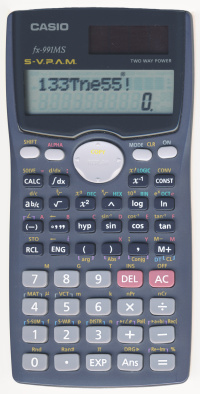
Casio fx-991MS displaying l33tness

Standard tricks

These tricks are just built-in features of the calculator that are not entirely obvious, because the previous generation of scientific calculators did not have these features.

Solve polynomials and linear systems

To solve a quadratic or cubic polynomial equation:
  1. Go to EQN mode and scroll over to the Degree? section (MODE MODE MODE 1 →).
  2. Enter the degree (2 or 3).
  3. Enter the 3 or 4 (real) polynomial coefficients, from highest degree downward.
  4. Scroll up and down through the solution set. Complex-valued solutions are included.
To solve a system of linear equations in 2 or 3 variables:
  1. Go to EQN mode and stay at the Unknowns? section (MODE MODE MODE 1)
  2. Enter the number of variables, which is also the number of equations (2 or 3)
  3. Enter the 6 or 12 coefficients of the system of linear equations.
  4. Scroll up and down through the solution vector.
Polynomials equations and linear systems are frequently occurring problems in mathematics and sciences, which makes this calculator feature one of the most useful ones.

Solve arbitrary equations

To solve an arbitrary equation of one variable:
  1. Enter the equation on the formula line. (e.g., 3X−8=5)
  2. Press SOLVE (SHIFT CALC).
  3. Give an initial guess for the variable and press the equals button. Try to give a value near an actual solution, or else solving will be slow or will fail. (However if the equation is linear, then any initial value works.)
  4. Press SOLVE again (SHIFT CALC). You may need to wait a few seconds.
  5. Read the result. (e.g., X=4.333333333)
The calculator uses a form of Newton’s method (as mentioned in the manual) to solve the equation. The algorithm can easily hang, fail, or give a wrong answer, so beware – it is not an automatic solver for all equations.
Tip: Although linear equations are simple to solve in theory, letting the calculator solve it for you can still save you some algebraic manipulation. Here’s an example problem: The 3 angles in a triangle are AB, and CB is twice of AC is triple ofB. Find the value of B. The solution can be found by solving the equation B÷2+B+3B=180.

Evaluate a function at many points

You can evaluate an arbitrary function (of one or more variables) at different arguments without re-entering the function’s definition repeatedly. Procedure:
  1. Enter the expression defining the function. (e.g. X2+Y)
  2. Press CALC.
  3. For each variable in the expression, give it a value.
  4. Read the value of the evaluated expression.
  5. To evaluate the function at another argument, go to step 2 (not step 1).
For example, this makes it much easier to use the rational root theorem to factor or solve polynomials.

Random number generation

The pseudo-variable Ran# (SHIFT .) gives a uniformly distributed random number in the range [0, 1) with a step size of 0.001. It takes on a random value for each instance in a formula and for each evaluation of a formula. (e.g. Ran#+Ran# has a different distribution than 2Ran#.)
To get an integer in the range [0, N), evaluate N×Ran# and mentally discard the fractional part of the result. This can be useful answering multiple-choice questions, e.g. Go left or go right?.
To get a finer step size, use Ran#+0.001Ran# (step size 10−6) or Ran#+0.001Ran#+0.000001Ran# (step size 10−9).

Degree-minute-second conversion

We inherited the sexagesimal (base-60) system from the Babylonians. While it makes some division problems easier for mental arithmetic, generally speaking decimal fractions are far easier to work with in practice. But for those times when you do need to work in sexagesimal or convert between it and decimal, this calculator comes to the rescue. It supports number input in degree-minute-second format, and can convert to and from decimal format. See the manual for details, or just play around with the °′″ button.
Obviously, this feature is useful for doing calculations with angles expressed in DMS notation. But I think it’s less well known that it helps calculations involving time, too. Don’t you remember that there are 60 minutes in an hour and 60 seconds in a minute? These subdivisions are the same as the DMS scheme.
To illustrate how DMS features can be used to solve time-related problems, I present some example exercises:
  • You arrived at work at 08:42:44 and left at 17:24:59. How long were you present at work?
    Answer: 17°24°59° − 08°42°44°, which yields 8°42°15. This means 8 hours, 42 minutes, and 15 seconds. Pressing the °′″ button swiftly converts this answer to about 8.70 hours.
  • You start driving at 21:30:00 at a speed of 30 m/s, and you need to travel 150 km. At what time will you reach your destination?
    Answer: 21°30° + 150×1000÷30÷3600, which yields 22:53:20 (exact).

Numerical differentiation

The numerical differentiation operation (SHIFT ∫dx) takes 2 or 3 arguments:
  1. The function of X to differentiate
  2. The point where the derivative is evaluated at
  3. The change in X (optional)
For example: d/dx(X^X,0.5) = 0.216976666. (The true value is about 0.216977710.)

Numerical integration

The numerical integration operation (∫dx) takes 3 or 4 arguments:
  1. The function of X to integrate
  2. The lower limit
  3. The upper limit
  4. The amount of partitioning (optional)
If the amount of partitioning is n, then the number of partitions is 2n. See User’s Guide 2 for more details.
Example of usage, while varying the amount of partitioning:
  • ∫(X−1,1,2,1) = 0.7
  • ∫(X−1,1,2,2) = 0.69
  • ∫(X−1,1,2,3) = 0.6932
  • ∫(X−1,1,2,4) = 0.69315
  • ∫(X−1,1,2,5) = 0.693147
  • ∫(X−1,1,2,6) = 0.6931472
  • ∫(X−1,1,2,7) = 0.69314718
  • ∫(X−1,1,2,8) = 0.693147181
  • ∫(X−1,1,2,9) = 0.69314718
The true value is ln 2, approximately 0.693147181.
Warning: Most functions integrate much more slowly and yield more error than this example.

Display and key test

To enter the calculator’s display and key test mode, press and hold SHIFT and 7, then ON. To exit the test at any time, press ON. (Note: Pressing 7 is not necessary on some older versions of this calculator.)
The first phase is the display test. Press SHIFT to step through the sequence of LCD patterns:
  1. All segments on
  2. All segments off
  3. Half of segments on
  4. The other half of segments on
  5. Many copies of a single digit, from 0 to 9
The last display test shows 999999999999. Pressing SHIFTagain starts the second phase, the key test. To complete the test, press every key (except ON) in order from left to right, top to bottom. The number on the screen increments every time you correctly hit the next key in the sequence. Don’t press ONunless you intend to quit!

Iterating formulas

A major difference between this calculator and older scientific calculators is that this calculator does not evaluate the expression while you input it. After you finish entering the expression, you press the equals key (=) and the calculator evaluates the expression all at once.
The most recent expression evaluated can be re-evaluated simply by pressing the equals key. The result of each evaluation is always saved in the answer variable (Ans). For single-statement iterations, it is most convenient to use Ans as the iterated variable. For example, Ans+1 is functionally equivalent but easier to type than X=X+1.
Multi-statement iterations can be written by using colon (ALPHA ∫dx) to separate the statements. When evaluating, press the equals key once per statement, and the calculator evaluates them in sequence. When all the statements in the line have been evaluated, pressing the equals key will go back to evaluating the first statement. For example, A=A+2:B=B−3 is a multi-statement line.
Remember to give initial values to all the variables used in the iterations.

Simple iterations

Arithmetic sequence
For example, starting at 0 and counting up by 1:
  1. Initialize: Evaluate 0 (sets Ans to 0).
  2. Iterate: Evaluate Ans+1.
Geometric sequence
For example, starting at 1 and doubling:
  1. Initialize: Evaluate 1 (sets Ans to 1).
  2. Iterate 2Ans.
Repeated squaring
For example, starting at 1.000000001 and squaring:
  1. Initialize: Evaluate 1.000000001 (sets Ans to 1.000000001).
  2. Iterate Ans2.
(The value overflows after 38 iterations.)
Logistic map
For example, the chaos at r = 4:
  1. Initialize: Evaluate 0.2 (sets Ans to 0.2).
  2. Iterate 4Ans(1−Ans) and watch the randomness.

Newton’s method iteration

To solve an equation of the form f(x) = 0:
  1. Set Ans to an initial value close to a root (solution).
  2. Iterate the expression Ans − f(Ans)/f′(Ans), where f′ is the derivative of f.
For example, to solve x2 − 3 = 0:
  1. Initialize: Evaluate 1000(Ran#−0.5).
  2. Iterate Ans−(Ans2−3)/(2Ans).
After a number of iterations, the result should converge to 1.732050808 or −1.732050808, depending on the initial value.

Fixed point iteration

It is possible to solve equations of the form f(x) = x by simply iterating xnext = f(x).
Examples:
  • Iterating cos Ans, the answer converges to 0.739085133 in radians mode and 0.999847741 in degrees mode.
  • Iterating e−Ans (i.e., eAns), the answer converges to 0.567143290.
Unfortunately, fixed point iteration is generally slower and less reliable than Newton’s method.

Taylor series iterations

We can manually simulate some elementary functions using naïve Taylor series.
Exponential function
  1. Initialize X with the argument of your choice.
  2. Initialize: Y=1A=0C=0
  3. Iterate: A=A+Y : Y=YX÷(C+1) : C=C+1
  4. Read the answer from A.
Cosine function
  1. Initialize X with the argument of your choice.
  2. Initialize: Y=1A=0C=0
  3. Iterate: A=A+Y : Y=−YX2÷(C+1)÷(C+2) : C=C+2
  4. Read the answer from A.
Sine function
  1. Initialize X with the argument of your choice.
  2. Initialize: Y=XA=0C=1
  3. Iterate: A=A+Y : Y=−YX2÷(C+1)÷(C+2) : C=C+2
  4. Read the answer from A.

Fibonacci sequence iteration

Procedure:
  1. Initialize: A=0B=1
  2. Iterate: C=A+B : A=B : B=C

Greatest common divisor iteration

This is based on the original Euclidean algorithm, which uses repeated subtraction rather than the modulus (remainder) operation. The procedure:
  1. Set the mode to complex numbers (MODE 2). (This is needed in order to use the absolute value function.)
  2. Initialize: Set A and B to be the natural numbers whose GCD will be computed.
  3. Iterate: A = A − B (tanh(20A−20B) + Abs tanh(20A−20B)) ÷ 2 : B = B − A (tanh(20B−20A) + Abs tanh(20B−20A)) ÷ 2. (Quite a mouthful, isn’t it?)
  4. When A and B converge to the same number, that number is the GCD answer.
Note that the function f(x) = (tanh(20x) − |tanh(20x)|) / 2 hackily emulates a step function, with f(x) = 0 for x ≤ 0 and f(x) = 1 forx ≥ 1. (This is due to the finite precision and rounding.)
Thanks to Bojan Petrovic for suggesting this trick!

Miscellaneous tricks

l33tsp34k

The calculator contains a palette of symbols, which can be used to spell out words and phrases in l33tsp34k. The complete (Latin) alphabet cannot be spelled out, but this can make the exercise more fun.
LetterCharacterMeaningKey sequence
AAVariable AALPHA (−)
4Digit 44
αFine structure constantCONST 10
BBVariable BALPHA °′″
8Digit 88
CCVariable CALPHA hyp
CCombination functionSHIFT +
DDVariable DALPHA sin
EEVariable EALPHA cos
EE notation separatorEXP
eExponential functionSHIFT ln
eElementary chargeCONST 23
eEuler’s numberALPHA ln
3Digit 33
FFVariable FALPHA tan
FFaraday constantCONST 22
fSI prefix femtoSHIFT 1
GGSI prefix gigaSHIFT 8
GGravitational constantCONST 39
gStandard gravityCONST 35
HhPlanck constantCONST 06
IiImaginary unitENG (only in complex mode)
1Digit 11
KkSI prefix kiloSHIFT 6
kBoltzmann constantCONST 25
L1Digit 11
MMVariable MALPHA M+
MSI prefix megaSHIFT 7
mSI prefix milliSHIFT 5
NnSI prefix nanoSHIFT 3
O0Digit 00
PPPermutation functionSHIFT ×
pSI prefix picoSHIFT 2
RRIdeal gas constantCONST 27
S5Digit 55
TTSI prefix teraSHIFT 9
tCelsius temperatureCONST 38
7Digit 77
UuAtomic mass unitCONST 17
XXVariable XALPHA )
×Times×
YYVariable YALPHA ,
Z2Digit 22
The letters that cannot be represented are J, Q, V, W. Discovering the punctuation that can be entered is left as an exercise for the reader.

Store 80 numbers

In the SD mode, you can store a sequence of up to 80 numbers, which persist even after a power cycle. To store a number, enter a literal number or an expression, then pressing DT (M+). To retrieve the numbers, scroll through the sequence of stored numbers by pressing up or down ().
In theory, any information can be stored as numbers. (Modern digital computers are built completely on this fact.) For example, if you want to store text on the calculator, just devise a coding scheme that maps between letters and numbers. Note that with the precision available, each number on this calculator can hold up to about 40.7 bits of information.

For more detail visit:http://www.nayuki.io